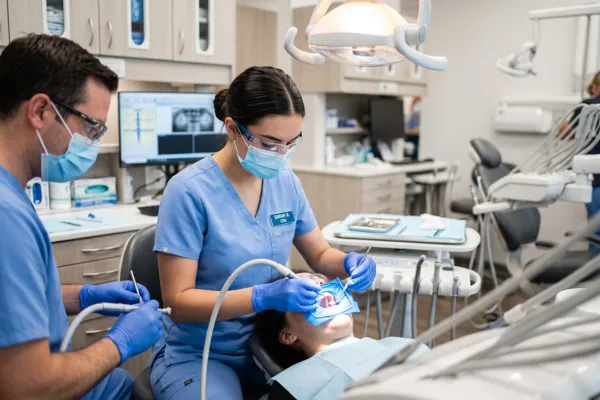
What Is EFDA Restorative Certification and How Do You Get It in Illinois?
If you have been working as a dental assistant for a while, you have probably heard other assistants mention "EFDA" and wondered what it actually means for your career. In Illinois, EFDA stands for Expanded Functions Dental Assistant, and that umbrella term actually covers a few different certifications, including coronal polishing, pit and fissure sealants, and coronal scaling. This guide focuses specifically on EFDA Restorative certification, the credential that lets you place, pack, and finish composite restorations under a dentist's supervision.
Here is what EFDA Restorative certification actually is, what it allows you to do, how much more it can help you earn, and exactly how to get it in Illinois.
What Does EFDA Restorative Certification Mean?
EFDA stands for Expanded Functions Dental Assistant, and in Illinois that term technically covers several different certifications, including coronal polishing, pit and fissure sealants, and coronal scaling. This article is specifically about EFDA Restorative certification, which authorizes a dental assistant to place, pack, and finish composite (tooth-colored) restorations under the direct supervision of a dentist.
In practical terms, this means an EFDA Restorative certified assistant is doing hands-on restorative work that a regular dental assistant, or an assistant certified only in coronal polishing or sealants, is not legally permitted to do. That added scope is exactly why EFDA Restorative certified assistants are in higher demand, and typically paid more, than assistants limited to basic or single-function duties.
How Much More Do EFDA Restorative Assistants Earn?
Certification is not just about scope of practice, it also shows up in your paycheck. According to 2026 salary data from ZipRecruiter, the average Expanded Function Dental Assistant in Illinois earns about $46,609 a year, or roughly $22.41 an hour. That compares to about $40,838 a year, or roughly $19.63 an hour, for a general dental assistant in the state.
That works out to close to a $5,800 annual difference, or roughly a 14 percent pay increase, just for holding expanded functions restorative certification. Actual pay varies by employer, location, and experience, but the trend holds across most sources: EFDA Restorative certified assistants consistently out-earn assistants without it.
What You Need Before You Can Enroll
EFDA Restorative certification is not an entry-level credential. Illinois requires dental assistants to have real clinical experience before they can even enroll in an EFDA Restorative course. Specifically, you need:
At least 4,000 hours (roughly 2 years) of clinical patient care experience as a working dental assistant
Completion of an approved Coronal Polishing and Dental Sealants course
If you have not yet completed coronal polishing and sealants training, that has to happen first, since it is a prerequisite, not something you can do alongside EFDA Restorative. Dental AssistEd offers a combined Illinois Coronal Polishing and Pit and Fissure Sealants course so assistants can complete both prerequisites at once instead of taking two separate courses.
If you are brand new to dental assisting and do not have any of this experience yet, EFDA Restorative is not your starting point. Look into an entry-level program like Dental AssistEd's 8-Week Become a Dental Assistant Program first, build your clinical hours, then come back to EFDA Restorative once you qualify.
What the EFDA Restorative Course Actually Covers
An Illinois-approved EFDA Restorative course is a mix of didactic (classroom/online) instruction and hands-on clinical training. Typical curriculum includes:
Dental nomenclature and caries classifications
Oral anatomy and the periodontium
Basic occlusion
Restorative instrumentation
Pulp protection liners and bases
Dental materials science
Matrix and wedge techniques
Amalgam placement and carving
Composite packing and finishing
Rubber dam clamp placement, isolation, and removal
At Dental AssistEd's EFDA Restorative Certification course, this breaks down into 16 hours of online didactic study completed before the in-person portion, followed by 4 full days of hands-on, manikin-based clinical instruction (14 hours) at their Chicago training facility.
Is EFDA Restorative the Same as a Continuing Education (CE) Course?
No, and this trips a lot of people up. EFDA Restorative is a certification course, not a CE course. When you complete it, you receive a certificate authorizing you to perform expanded functions restorative procedures under direct dentist supervision, since it is a credentialing course, not a credit-hour requirement you renew annually. If what you are actually looking for is CE credits to maintain an existing license or certification, take a look at Dental AssistEd's online CE courses, that is a separate category of course entirely.
Who Approves EFDA Restorative Certification in Illinois?
For a course to count, it needs to be recognized by the right regulatory bodies. In Illinois, that means the EFDA Restorative course must meet the requirements outlined in the Illinois Dental Practice Act and be recognized by the Illinois Department of Financial and Professional Regulation (IDFPR).
Dental assistants in Indiana can generally take the same approved course, since many EFDA Restorative programs, including Dental AssistEd's, are also recognized by the Indiana Professional Licensing Agency (PLA) and align with Indiana's Dental Practice Act as well. If you are unsure whether a specific course counts in your state, it is worth confirming directly with the training provider before you enroll, since not every course carries both approvals.
What Does EFDA Restorative Certification Cost, and How Long Does It Take?
Cost and format vary by provider, but as a benchmark, Dental AssistEd's EFDA Restorative Certification course runs $3,700 and takes place over 4 full days (9:00 AM to 4:00 PM) at their Chicago, Illinois facility, following the 16 hours of online didactic work. The course is offered multiple times per year, and team enrollment is available for dental practices looking to certify more than one assistant at a time.
The Bottom Line
EFDA Restorative certification is one of the clearest ways to move from basic chairside duties into real restorative clinical work, and the pay data backs that up. But it comes with real prerequisites: 4,000 hours of experience and a completed coronal polishing and sealants course. If you already meet those requirements and you are ready to expand what you are legally able to do in the operatory, and what you are paid for it, EFDA Restorative is worth pursuing.
If you are in Illinois or Indiana and ready to take the next step, explore the EFDA Restorative Certification course at Dental AssistEd, or contact us to confirm you meet the prerequisites before you enroll.
