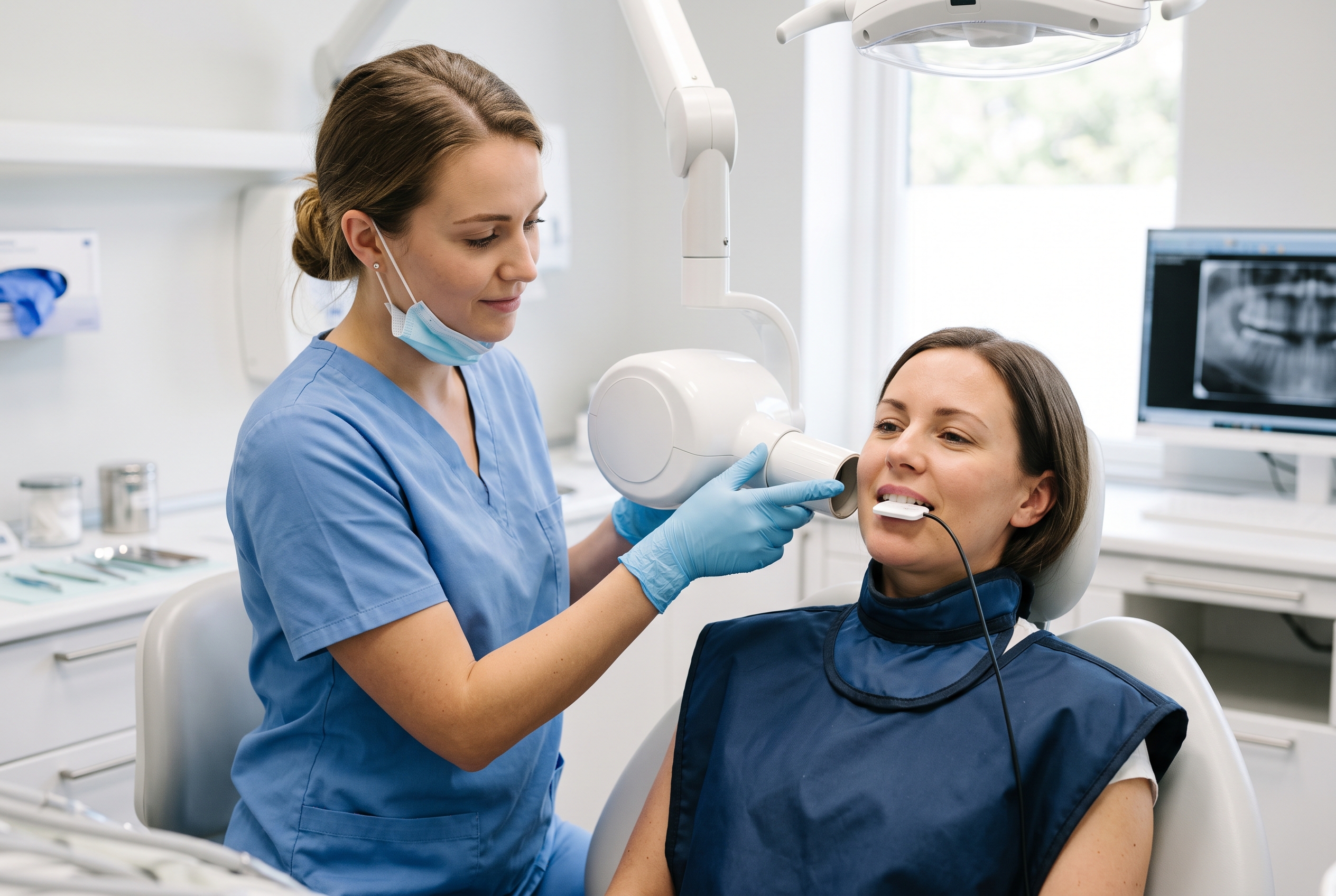
Do You Need an X-Ray License to Be a Dental Assistant in Illinois?
No. Illinois does not require dental assistants to hold a state X-ray license or radiography certification. The Illinois Dental Practice Act specifically allows dental assistants to operate dental X-ray machines, and there's no separate state exam to pass. But "no license" doesn't mean "no training." Illinois radiation safety rules require your dental office to train you before you take X-rays and every year after that, and if you work in Indiana, the rules are much stricter. Here's how it all works.
What Illinois Law Actually Says
The Illinois Dental Practice Act lists certain tasks that don't count as practicing dentistry without a license. One of them is "the use of X-Ray machines for exposing X-Ray films of dental or oral tissues by dental hygienists or dental assistants" (225 ILCS 25/17). In other words, taking dental X-rays is something the law expressly allows dental assistants to do.
The IDFPR rules that spell out dental assistant duties also don't set a separate radiography course or exam requirement. That's different from expanded functions like coronal polishing, pit and fissure sealants, and nitrous oxide monitoring, which each require an approved course before you can perform them. So in Illinois, there's no state-issued "X-ray license" for dental assistants, because one doesn't exist. For the bigger picture on credentials, see our guide on whether you need a certificate to work as a dental assistant.
No License Doesn't Mean No Training
Illinois regulates X-ray equipment separately, through the Illinois Emergency Management Agency and Office of Homeland Security (IEMA-OHS). Its rules for dental and medical X-ray use (32 Ill. Adm. Code 360.30) require every office that runs X-ray equipment to:
Give each person who operates the equipment written operating and safety procedures
Provide initial and annual in-service radiation safety training to everyone who takes X-rays, other than licensed practitioners
Make sure operators are instructed in, and can demonstrate competence with, the office's operating and safety procedures
So even without a license, you'll need to be trained before you take X-rays on patients, and that training doesn't end after your first week. The real question isn't whether you'll be trained, it's whether that training is informal on-the-job instruction or a structured course.
Why Many Illinois Assistants Take a Radiation Health and Safety Course Anyway
Since there's no state license, a formal course is optional for Illinois dental assistants. Plenty still take one, for a few practical reasons:
It makes you easier to hire. Taking X-rays is one of the most common duties in a general dental office. Showing up already trained means an office can put you in the chair sooner, which is a real advantage if you're new to the field. Our guide on how to get hired as a dental assistant with no experience covers more ways to stand out.
It protects your patients and you. Understanding exposure, positioning, and shielding means fewer retakes and less unnecessary radiation for everyone in the room.
It builds toward national certification. Radiation Health and Safety (RHS) is one of the three exams that make up DANB's Certified Dental Assistant (CDA) credential, so a solid foundation now pays off if you pursue CDA later.
It travels with you. If you ever work in a state that does regulate dental radiography, including Indiana, you'll already understand the fundamentals.
What a Radiation Health and Safety Course Covers
Dental AssistEd's Radiation Health and Safety course is built for dental assistants, hygienists, dentists, and any office staff involved in taking or assisting with radiographs. It covers:
Radiation physics and biology
DANB and state radiation safety guidelines
Correct patient positioning for diagnostic-quality images
Digital vs. film radiography techniques
How to reduce radiation exposure and prevent retakes
Safety protocols for both patients and operators
The course is $70, fully online and self-paced, and approved by IDFPR, the Indiana Professional Licensing Agency, and the Illinois Board of Higher Education. It's worth 2 PACE-approved CE credits, and you get an instant printable certificate when you finish. Enroll in the Radiation Health and Safety course.
What About Indiana?
Indiana is a different story. Dental assistants in Indiana need an Indiana Dental Radiographer License, issued by the Indiana Department of Health, before they can take X-rays. According to IDOH's licensing requirements, you need to:
Graduate from a CODA-accredited dental radiography program or an IDOH-approved radiography education program
Complete clinical training under a student or provisional permit
Pass either DANB's Radiation Health and Safety (RHS) exam or its Certified Dental Assistant (CDA) exam
Submit your license application with a $60 fee
That's a bigger commitment than a single online CE course, so if you're planning to work in Indiana, build the licensing program into your timeline. Our guide on how to become a dental assistant in Indiana walks through the rest of the path.
For Dental Offices: Radiation Training Is Ongoing
If you manage a dental office, the IEMA-OHS rules above mean radiation safety training isn't a one-time box to check at hiring. Every non-licensed team member who takes X-rays needs initial training plus annual in-service training on your office's procedures. A structured course gives new hires a consistent, documented foundation, while your office covers its own equipment and policies. Dental AssistEd offers team enrollment for the Radiation Health and Safety course so your whole staff can complete it on their own schedules.
The Bottom Line
You don't need an X-ray license to be a dental assistant in Illinois. State law allows dental assistants to take dental X-rays, and there's no state radiography exam to pass. What you do need is training: Illinois radiation safety rules require your office to train you before you start and every year after. Indiana is stricter and requires a state Dental Radiographer License.
A Radiation Health and Safety course is the simplest way to show up trained, stand out to employers, and build a foundation before you move on to expanded functions like coronal polishing and sealants. Explore the Radiation Health and Safety course or contact us if you're not sure what your role requires.
