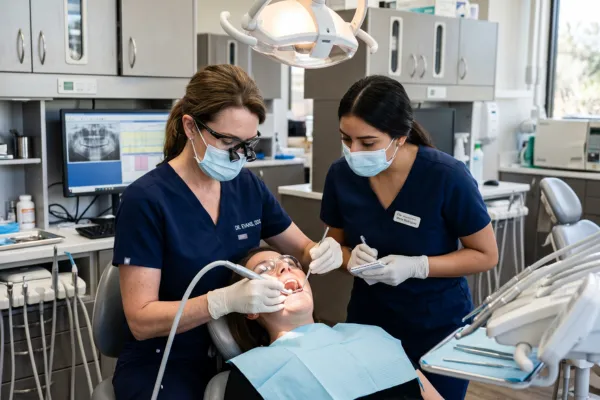
Can Dental Offices Train You While You Work?
Yes, and it happens more often than you might think. Plenty of people land their first dental assisting job with no formal training and learn everything on the job. Dentists are legally allowed to do this in most states, including Illinois and Indiana.
But there's a ceiling to what on-the-job training can actually give you, and it's worth understanding that before you decide whether to rely on it.
What Dental Offices Can Legally Train You On
In Illinois and Indiana, dental offices can hire someone with zero experience and train them for general chairside duties. This includes:
Handing instruments to the dentist during procedures
Suctioning and keeping the patient comfortable
Mixing materials and setting up trays
Sterilizing and maintaining instruments
Charting and basic administrative tasks
Assisting with X-rays (with proper radiation safety training)
For all of these, no formal certification is required. A dentist can teach you these skills in-house, and you can perform them legally once you've been trained by the practice.
This is why dental assisting is one of the more accessible healthcare careers. You don't need a license to start working at the basic level in either state.
What On-the-Job Training Can't Give You
Here's where it gets important. The moment a procedure crosses into expanded functions, on-the-job training is no longer enough. In both Illinois and Indiana, expanded functions require a state-approved certification course before you can legally perform them, regardless of how much in-house training you've had.
In Illinois, expanded functions that require IDFPR-approved certification include:
Coronal polishing - cleaning and polishing tooth surfaces
Pit and fissure sealants - applying protective coating to back teeth
Coronal scaling - supragingival scaling procedures
Restorative functions (EFDA) - placing and finishing composite restorations
In Indiana, the following require Indiana PLA-approved certification:
Coronal polishing with fluoride application
Pit and fissure sealants
A dentist cannot legally train you to perform these procedures in-house and call it done. Even if they walk you through every step themselves, you still need the formal certification to do them legally. And if something goes wrong and you're performing an expanded function without that credential, both you and the dentist are exposed to serious liability.
What On-the-Job Training Actually Looks Like
In practices that train new hires, the experience varies a lot depending on the office. Some are very structured, with senior assistants mentoring new hires through each step. Others are more of a "figure it out as you go" situation where you're learning by watching and jumping in when needed.
What most offices are good at teaching:
Their specific workflow and how they like procedures set up
Which materials they use and how to handle them
How to work with their particular patient base
Practice-specific software and administrative systems
What most offices aren't equipped to teach:
Formal clinical technique for expanded functions
State compliance and documentation requirements
The kind of hands-on skill development that comes from a structured training environment
On-the-job training gives you experience. Certification courses give you credentials. You need both if you want to grow in this career.
When Your Office Might Pay For Your Training
Something worth knowing: some dental offices will sponsor their assistants for certification courses once they're hired. If a dentist sees potential in you and wants to keep you long-term, it's in their interest to invest in making you more qualified.
This doesn't happen everywhere, but it does happen. If you're starting a new job, it's a completely reasonable question to ask during or after the hiring process: "Are there any opportunities for certification training down the line?"
Even if they say no, you can pursue certifications on your own. Short state-approved courses don't require you to take time off work. Most are structured as weekend or multi-day programs that fit around a normal work schedule.
Illinois: The 1,000 Hour Requirement
One thing specific to Illinois is worth flagging. For most expanded function certifications, the state requires 1,000 hours of on-the-job dental assisting experience before you can enroll in the certification course.
This means the path for most people in Illinois looks like this:
Get hired as an entry-level dental assistant (no certification required)
Build up your clinical hours while working
Once you hit 1,000 hours, enroll in an IDFPR-approved certification course
Complete the course and earn your credential
So in Illinois, on-the-job training isn't just an alternative to formal education. For many expanded function certifications, it's actually a prerequisite. You need those hours before you can even qualify for the course.
The exception is the 8-Week Become a Dental Assistant Program at Dental AssistEd, which is a full training program that prepares you to enter the field rather than a standalone certification course. That's a different path designed for people who want to come in fully prepared from the start.
So Should You Rely on On-the-Job Training?
It depends on your goal.
If you want to get hired quickly and learn the basics: Getting hired without prior training and learning on the job is a completely valid starting point. Many successful dental assistants started exactly this way.
If you want to perform expanded functions and earn more: You'll need state-approved certifications regardless of how much in-house training you've had. On-the-job experience gets you in the door and builds your hours, but the certification is what unlocks the expanded role.
If you want to come in fully prepared from day one: A structured training program before you start working gives you a real advantage. You'll be more confident, more useful to the practice immediately, and you'll spend less time figuring things out on your feet.
Ready to Get Certified?
If you're already working as a dental assistant in Illinois or Indiana and ready to add state-approved certifications to your resume, we offer IDFPR and Indiana PLA-approved courses designed to fit around your schedule:
If you're not yet working and want to come in trained, the 8-Week Become a Dental Assistant Program is the fastest way to enter the field prepared. Illinois residents may qualify for a WIOA grant that covers the cost entirely.
Explore all courses at Dental AssistEd or contact us and we'll help you figure out the right next step.
