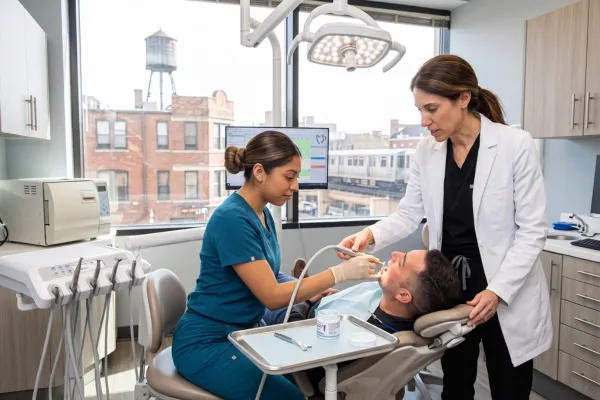
How Long Does It Take to Train as a Dental Assistant?
If you are in Illinois and wondering how long it actually takes to become a dental assistant, the honest answer is: it depends on the path you choose. You could be working in a dental office in a matter of weeks, or you could spend a year in a formal program. Neither is wrong, but they lead to different starting points in your career.
Here is a breakdown of each path and how long each one realistically takes.
Path 1: Get Hired With No Training (Fastest - Days to Weeks)
In Illinois, you can legally get hired as a dental assistant with zero prior training. Some dental offices are willing to bring on a motivated person and teach them the basics on the job.
If this is your route, there is no training period before you start. You apply, you interview, and if hired, you start right away. The learning happens during the job itself.
The tradeoff is that you will be limited to basic chairside duties only: handing instruments, suctioning, charting, sterilizing equipment. You will not be able to perform any expanded functions until you have the required certifications and clinical hours.
This is the fastest way to get a paycheck in a dental office, but it is not the fastest way to build a real career.
Path 2: Complete an 8-Week Training Program (8 Weeks)
For most people, the smartest and fastest combination of speed and preparation is an 8-week dental assistant training program. In 8 weeks you cover everything you need to walk into a dental office and contribute from day one, no guessing, no figuring things out on the fly.
At Dental AssistEd, the 8-Week Become a Dental Assistant Program is designed exactly for this. You get hands-on clinical training in a structured environment, not a generic online course. By the end of 8 weeks, you are job-ready and confident.
This is the path we recommend for most people who are serious about entering the field prepared rather than piecing things together after getting hired.
Illinois residents may qualify for a WIOA grant that covers tuition 100%. The Workforce Innovation and Opportunity Act is a federal program that funds training for people entering in-demand careers. Dental assisting qualifies, and we guide students through the process so you are not navigating it alone.
Learn more about the 8-Week Program and the WIOA grant here.
Path 3: Community College or Vocational Program (9 to 12 Months)
Some people choose to complete a longer dental assisting program through a community college or vocational school. These programs typically take 9 to 12 months and cover a broader range of dental topics, sometimes including an externship component.
The upside is a more comprehensive foundation. The downside is the time commitment. If your goal is to start working quickly, a year-long program delays that significantly. These programs also tend to cost more than shorter alternatives.
This path makes the most sense if you are not in a rush and want the most thorough foundation possible before entering the field.
How Long Does It Take to Get Certified for Expanded Functions in Illinois?
This is a separate question that a lot of people miss. Getting hired is one thing. Getting certified to perform expanded functions in Illinois is another timeline entirely.
In Illinois, most expanded function certifications require you to have 1,000 hours of on-the-job dental assisting experience before you can even enroll in the certification course.
So for expanded functions like coronal polishing, pit and fissure sealants, coronal scaling, or EFDA restorative, the realistic timeline looks like this:
Get hired and start working (immediately, or after training)
Build 1,000 hours of clinical experience (roughly 6 months full-time)
Enroll in and complete a state-approved certification course - IDFPR-approved for Illinois or Indiana PLA-approved for Indiana (course length varies by certification)
Receive your certification and begin performing expanded functions
So from zero to fully certified for expanded functions in Illinois, you are realistically looking at 6 to 12 months total depending on your starting point and how quickly you accumulate hours.
Indiana follows the same hour requirements. The key difference is that Indiana requires coronal polishing to be combined with a fluoride application course. That is why at Dental AssistEd, our Illinois course offers coronal polishing on its own, while our Indiana course includes fluoride as part of the package.
Illinois and Indiana Timeline Summary
Path 1: Get hired with no prior training
Time to start working: Days to weeks
Time to first expanded function certification: 6 to 12 months
Path 2: Complete an 8-Week Training Program
Time to start working: 8 weeks
Time to first expanded function certification: 6 to 9 months
Path 3: Community College or Vocational Program
Time to start working: 9 to 12 months
Time to expanded function certifications: 15 to 18 months
What Certifications Can You Get and How Long Do They Take?
Once you meet the hour requirements, the certification courses themselves are shorter than most people expect. Here is what is offered at Dental AssistEd and what you need before enrolling:
Illinois Courses:
Coronal Polishing - Online portion + 1 day hands-on session. Requires 1,000 hours (6 months) of clinical experience.
Pit and Fissure Sealants - Online portion + 1 day hands-on session. Requires 1,000 hours (6 months) of clinical experience.
Coronal Polishing and Sealant Placement Combined - Online portion + 1 day hands-on session. Requires 1,000 hours (6 months) of clinical experience.
Coronal Scaling - Online portion + 3 days hands-on session. Requires a Coronal Polishing certification before enrolling and 2,000 hours (1 year) of clinical experience.
EFDA Restorative - Online portion + 4 days hands-on session. Requires both a Coronal Polishing certification and Sealant Placement certification before enrolling, lastly 4,000 hours (2 years) of clinical experience.
Indiana Courses:
Indiana Coronal Polishing and Fluoride - Online portion + 1 day hands-on session. Requires 1,000 hours (6 months) of clinical experience.
Indiana Pit and Fissure Sealant - Online portion + 1 day hands-on session. Requires 1,000 hours (6 months) of clinical experience.
Indiana Coronal Polishing, Fluoride and Sealant Placement - Online portion + 1 day hands-on session. Requires 1,000 hours (6 months) of clinical experience.
All courses at Dental AssistEd are IDFPR and Indiana PLA approved. They are designed to fit around a working schedule, most are completed over a weekend or a few days, not months.
The Bottom Line
The honest answer to how long it takes to train as a dental assistant in Illinois depends entirely on what you want to do.
If you want to start working as fast as possible, getting hired with no prior training is an option. If you want to come in prepared and confident from day one, an 8-week program is the fastest smart path. And if you want to eventually perform expanded functions and earn more, plan for roughly 6 to 12 months from start to certification.
The good news is that this is one of the faster healthcare careers to break into at any level. You do not need a four-year degree, and the certification courses are short once you qualify for them.
If you are in the Chicago area and ready to get started, explore our programs and courses at Dental AssistEd or contact us to figure out the right path for where you are right now.
